Free at last
2/12/2026, noon
It is a bitter irony that the final weeks of the Richmond Free Press have also been among its most technologically significant. Just weeks ago, severe weather forced the staff to produce its first fully remote issue, unable to gather at the newspaper’s longtime Franklin Street headquarters. This final edition marks another first — the Free Press’ inaugural digital-only publication — coming just one week after the presses rolled for the last time. Innovation, in this case, arrived not by design but by necessity and far too late to change the outcome.
While the Free Press may not have kept pace with the times, we certainly tried to make sense of them the best that we could. This became more challenging as our staff dwindled, budgets shrank and years of deferred maintenance caught up to us. And now, in February 2026, instead of planning coverage of Black History Month events across the city, the newspaper itself has become part of that history — another quiet irony.
When the Free Press first rolled off the presses, under the leadership of our founder, Ray Boone, it changed the game. He presented a public image that was unbought, unbossed and unafraid to speak truth to power. For competitors, the Free Press proved a difficult act to follow. It outlasted them — and even survived a lawsuit from the daily newspaper — carving out a space that had not existed before.
The media landscape has changed since those early days. Our founder died in 2014 at age 76. Richmond no longer has a daily newspaper. In place of the alternative publications that once filled that space, several online news organizations now provide strong, consistent coverage of the city and the commonwealth. As of this writing, three of the newsrooms based in the Richmond area are led by Black journalists. In addition, Black Virginia News has emerged as a digital platform offering reporting, podcasts, newsletters and other online content focused on Black life in the state.
We know this will offer little consolation to those who have read the Free Press for years and have grown accustomed to its presence in the community. It will offer even less to the quiet legion of men and women who took it upon themselves to redistribute our paper to rural outposts where Black people gathered. To all who supported the Free Press, we thank you. We hope we made you proud.
Although the presses have stopped, the Free Press’ commitment to truth, community and Black voices will endure in the lives it touched and the journalists it inspired.
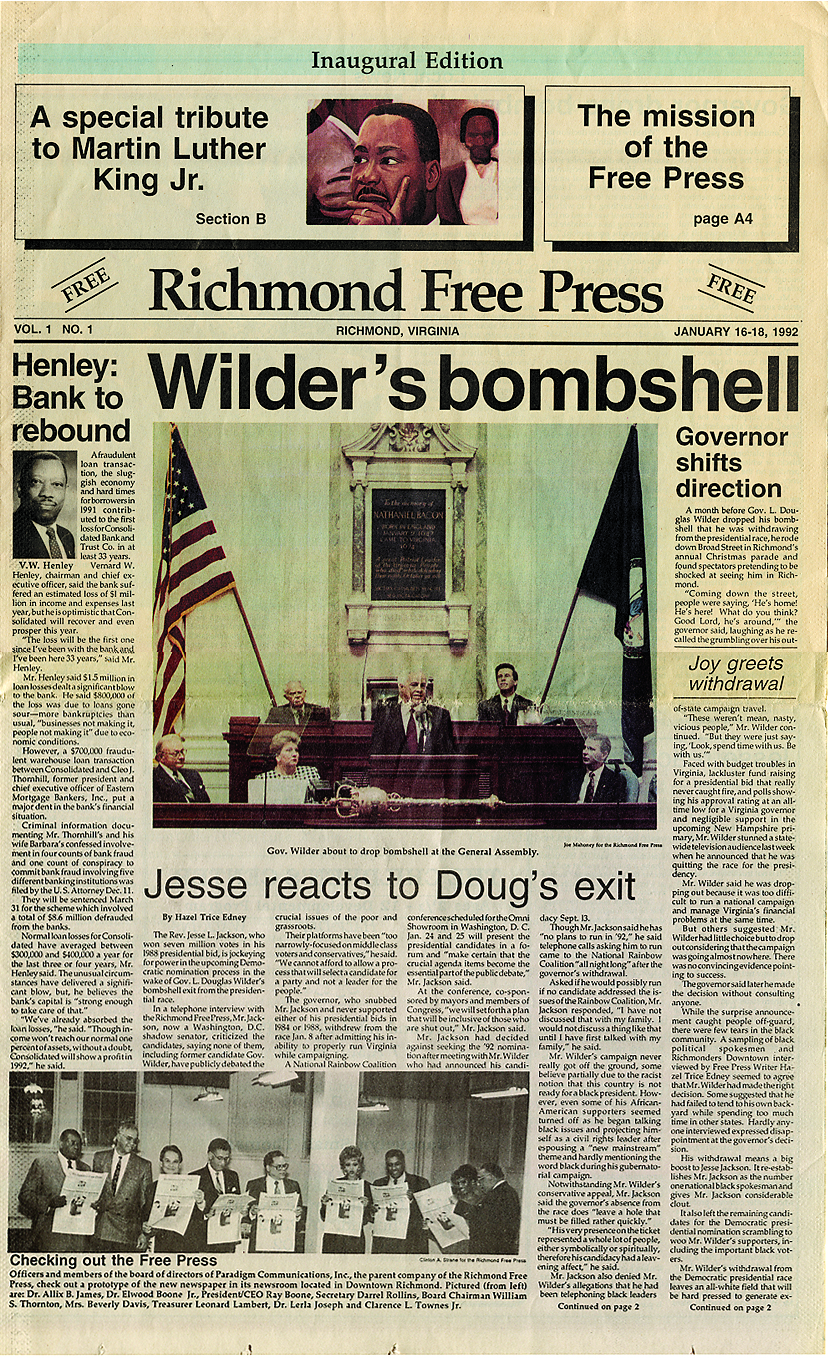
The very first edition of the Richmond Free Press newspaper hit the streets of Richmond in 1992. The photo at the bottom of the front page shows the board of directors of Paradigm Communications, the parent company of the Richmond Free Press checking out the publication’s prototype.