Public walls carry public responsibility
2/12/2026, noon
As a former member of the City of Richmond Public Art Commission, a former president of the Richmond Crusade for Voters, and someone who has engaged in dialogue with muralists across the country, we are keenly aware of how public art shapes urban communities — for better or for worse. Murals are not neutral. They communicate values, power and memory. When done responsibly, they uplift. When done carelessly, they harm.
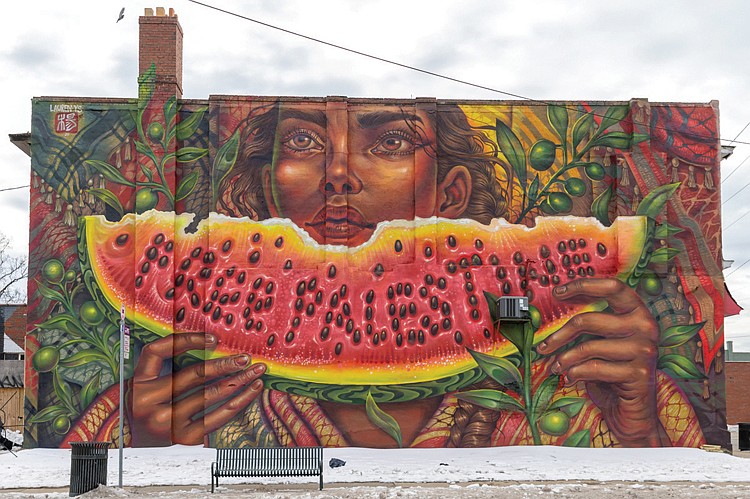
A mural recently installed at North Avenue and Brookland Park Boulevard depicts an Afro-Palestinian woman holding a slice of watermelon, surrounded by Palestinian symbols and paired with the political message “Free Palestine.” The stated intent was to highlight dignity and justice for the Palestinian people. While intentions matter, impact matters more — especially in public art that residents must live with every day.
The problem is this: the image of a Black person eating watermelon carries a deeply racist history in the U.S. For more than a century, beginning in the post-emancipation era, watermelon imagery was weaponized to caricature African Americans as lazy, childish and uncivilized. What had once symbolized Black economic independence became a tool of humiliation deliberately engineered to demean newly freed people. That history is not obscure. It is well-documented and deeply felt in Black communities.
In Palestinian culture, watermelon holds a very different meaning. Its colors mirror the Palestinian flag and it has become a symbol of resistance. Both of these truths can coexist. But when symbols from different cultures collide in public space, context is everything. What reads as resistance in one culture can read as racism in another. Placing that image — on a major intersection in a historically Black neighborhood, amid ongoing gentrification — without community consultation is not just careless; it is irresponsible.
We suggested to the artist that the watermelon imagery be reconsidered given this local history. While we do not believe the artist intended harm, good intentions do not erase harmful impact. Public art demands a higher ethical standard precisely because it is public. Artists must ask not only, “Is this provocative?” but also, “Who does this harm?” and “Who must live with this image every day?”
This raises a deeper and more troubling question: Has society become so racist or so ignorant that it is now considered acceptable to paint a mural of a Black woman eating watermelon and attach a global political message to her body without pause or reflection? We understand that we live in a moment where Black history is routinely erased, sanitized or dismissed. We understand that many Americans are deeply ignorant of that history. But we find it difficult to believe that no one involved — no organization, no property owner, no approving body — recognized the symbolism at play. Given the density of meaning in this mural, the failure to interrogate it suggests either ignorance or indifference. Neither is acceptable.
On the issue of Palestine, it is important to be clear: The Black community is not monolithic. Many Black activists and intellectuals have drawn parallels between the Palestinian struggle and the African American fight for civil rights, particularly around issues of state violence and systemic oppression. That solidarity has a long history dating to the 1960s. But there has never been a single, unified Black position on the Israeli- Palestinian conflict. Views are varied, complex and often deeply personal. So who gave permission to place such a powerful political message on the image of a Black woman in this community? No one in the neighborhood was consulted.
Were the Brookland Park Business Association or local neighborhood associations consulted before approval? Was there any meaningful community review at all? These questions remain unanswered — and that, in itself, is part of the problem.
Cities, arts councils, property owners and muralists must commit to ethical standards for public art. Community review must be a requirement, not an afterthought. Public walls carry public responsibility.
This may be a local wall, but it is a national issue. Public art should heal, not harm. It should unite, not alienate. And when it fails to do so — especially in historically marginalized communities — it must be reconsidered. This mural should be removed and replaced with art that respects local history, honors community voices and truly uplifts the people who call this place home.
GARY FLOWERS
JONATHAN DAVIS