Personality: Farrah Massenburg
Spotlight on Massey VCU breast cancer survivor and advocate
1/29/2026, 6 p.m.
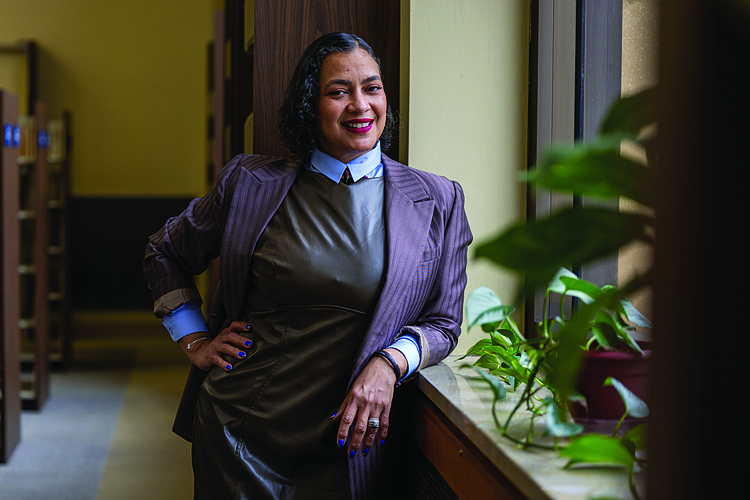
When Farrah Massenburg noticed a small lump while breastfeeding, she could not have anticipated what lay ahead. Within weeks, she was diagnosed with an aggressive form of breast cancer that, despite being in its early stage, required targeted therapies and personalized treatment.
Her diagnosis sparked a nearly two-year ordeal marked by missteps, a near-fatal reaction and ultimately survival — experiences that now fuel her advocacy for women battling breast cancer.
Massenburg’s first oncology team began a chemotherapy regimen immediately after her diagnosis, without conducting tests to assess her overall health. The treatment caused her to be hospitalized after each session. One round triggered a seizure, and twice she came close to death. Despite these complications, her doctors continued the same chemotherapy protocol, telling her that if she did not undergo treatment, she would have five years to live.
“In addition to the pain and sickness, I had Black women’s hair struggles to love my hair, only to lose it. I was sad because I couldn’t breastfeed my daughter and worried that she’d feel abandoned. My son asked me if I wanted to die,” Massenburg said. “A cancer diagnosis affects the whole family, but in different ways.”
A chance encounter with two women from the Massey Comprehensive Cancer Center at VCU changed the course of her cancer journey. After learning about her battle, they fast-tracked her for evaluation at the center. Massenburg says the difference in care was stark: her Massey VCU doctors humanized her treatment and prescribed a less intensive chemotherapy regimen.
“The doctors at Massey VCU use humanity and science to create pathways for patients,” she said. “They’ll let you know that they’re going to try to figure it out.”
Massenburg underwent eight surgeries, including a double mastectomy and reconstruction. She also had a hernia repair and endured weight gain from steroids and medications.
Now in remission, she advocates for breast cancer awareness and emphasizes the importance of second opinions to inspire others to take action. Her work with Women and Wellness at Massey VCU allows her to help raise funds for the lifesaving research and treatment available there. She will chair the organization’s 31st Women and Wellness luncheon next month.
“People don’t know how important second opinions are,” Massenburg said. “Massey VCU will evaluate other doctors’ treatment plans. What would happen to patients like me if they didn’t focus on listening?”
Black women in the U.S. are less likely to be diagnosed with breast cancer but much more likely to die from it than white women. According to the American Cancer Society, Black women are dying at a nearly 40% higher rate from the disease than white women.
“It’s not just about the patient; it’s about the treatment plan and what the doctors do. Massey VCU has allowed me to become a walking billboard,” Massenburg said.
What is the Women and Wellness at VCU Massey Comprehensive Cancer Center?
It’s an annual fundraising and education program dedicated to fighting women’s cancers. Our signature event is the luncheon next month at The Jefferson Hotel.
What kind of advocacy work do you do at the center?
We try to figure out the why and what’s the next step. I try to make things fun, like recruiting volunteers and reaching out to lingerie boutiques for bra donations and to pharmaceutical companies and nurses for donations.
Why are you such a fierce advocate?
I’m a breast cancer conqueror. I wondered who else is going through this. You don’t go into detail about your journey because you don’t feel comfortable. I advocate because there are women who work, who are mothers and who do a lot of things. We shouldn’t have to do it all by ourselves.
What do you tell women who are going through their cancer journey?
If I hear someone going through it, I offer mental support. I know they don’t want to hear “I’m sorry,” but we know people are trying to be consoling. I understand what they’ve gone through. I tell them that the light that shines on them should not be bigger than the light in them. I encourage them to use their power wisely because everyone has a superpower.
How did your husband help with your cancer journey?
Some women are going through cancer and their husbands are leaving them. I was lucky. My husband cared for me when I couldn’t walk, changing tubes, washing, wiping, staying in the hospital with me and taking care of the kids.
How have things changed since your diagnosis?
I was very active with softball — very athletic. Now, I feel like I’m more fragile, especially with the surgical scars. I get sicker quicker, and I have to work a little harder mentally and physically. I haven’t said these things out loud before. It’s like training for your own personal marathon. I still wear bright lipstick because I wanted to look cute when I was bald.
What’s your prognosis?
I’m in remission. I don’t have to use a walker or a cane. I’ve lost the weight. I’m cancer-free, but I have to do scans and bloodwork regularly.
Tell me about your family.
My husband and I have four kids, two boys and two girls.
What’s your educational background?
I have a bachelor’s in psychology, pre-med from Virginia Commonwealth University.
What do you do for a living?
I’m the founder and president of Inclusive Infrastructure Solutions. It’s a construction consultancy. Alphonso Hugo “Al” Bowers Jr. was my dad. I followed in my father’s footsteps, promoting diverse inclusion in government building projects.
Where are you from?
I’m originally from Greensboro. My family moved to Richmond when I was 16.
Where do you live now?
Eastern Henrico.
What do you do in your downtime?
I love to cook. I have a catering business with a good friend. I love gardening and growing fresh herbs for cooking.
What do you like to cook?
I make all kinds from scratch. I like to see how my food makes people feel. I make blueberry biscuits. I love my butter chicken. My oldest daughter likes pho soup, so we make that.
What’s your favorite hobby?
I like feeding my family because they all eat differently. Some are pickier than others. I love taking care of my family.
Who has influenced you the most?
Myself, because I didn’t realize how strong God made me. I had to learn that. If I’m not strong, how am I going to be strong for others?
What was the first thing you did when you were cancer-free?
I was able to ring the bell the second time. I had an outfit made. I went home and cooked. I made a huge dinner with things I couldn’t eat during the chemo, like cold cuts. I made gourmet sandwiches.
What’s next?
Growing my business and creating my legacy, focusing on my purpose — everything that I’m supposed to do.