Judge rules in favor of New York’s Abyssinian Baptist Church and its new pastor
By Adelle M. Banks Religion News Service | 12/31/2025, 6 p.m.
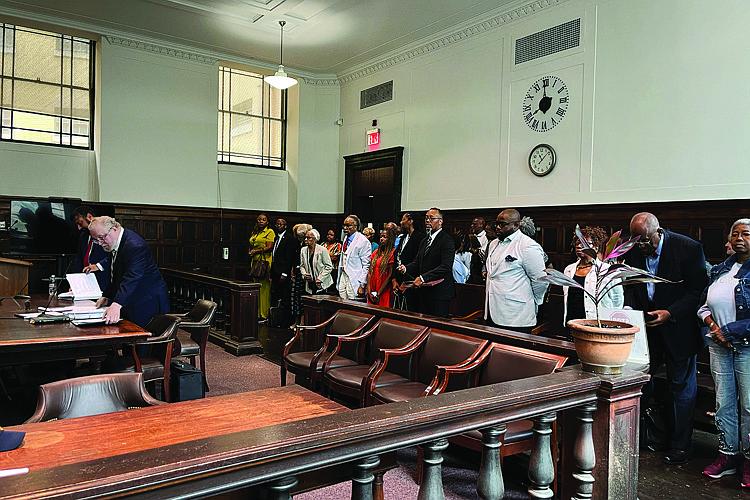
A New York State Supreme Court judge has ruled in favor of Harlem’s Abyssinian Baptist Church in a lawsuit brought by current and former members who challenged senior pastor the Rev. Kevin Johnson’s 2024 election and sought to remove him.
Johnson succeeded the Rev. Calvin O. Butts III, who served as minister at the historically Black church for 50 years and died in 2022. Johnson was installed in September 2024.
In their lawsuit filed in October 2024 in the Civil Branch of the New York Supreme Court, the plaintiffs — Kevin McGruder, Jasmine McFarlane- White, Clarence E. Ball III and the Rev. C. Vernon Mason Sr. — claimed Johnson’s election did not comply with the church’s bylaws. They sought to nullify his election and make him ineligible in future church elections.
But Judge James G. Clynes sided with Johnson and the church in a Monday, Dec. 22, decision, denying the request and saying the plaintiffs misinterpreted the bylaws’ statement that a senior pastor must be elected by “the majority vote of the members in good standing who are eligible to vote.” The plaintiffs argued the election was invalid because of low turnout. A total of 44% of registered members voted.
“The court disagrees with petitioners’ interpretation that the word ‘majority’ as used in the bylaws means anything other than a majority of the votes of the members who voted, not the majority of the members who were eligible to vote,” Clynes said. “As argued by respondents, any other interpretation of the term ‘majority’ in the bylaws would be unreasonable.”
Clynes also found that the church demonstrated “that no fraud or wrongdoing occurred during the June 21-23, 2024, election process and that the petition should be dismissed as a matter of law.”
The church hailed the ruling.
“This has been a long journey, and we want to express our profound gratitude to our congregation and supporters for your trust, patience, and prayers throughout this process,” the church said in a memo to members. “The court has now confirmed what we have known all along: the voice of the congregation was heard, and the will of the congregation was honored. We are ready to close this chapter and look forward with Rev. Dr. Kevin R. Johnson as the duly elected senior pastor.”
The four plaintiffs expressed disappointment.
“Though the Court has declined to hear our claims, we remain steadfast in our commitment to integrity, to one another, and to the principles that first drew us to Abyssinian,” they wrote in a statement on a GoFundMe page they set up. “We will continue to speak the truth as we know it, to support others who feel silenced, and to seek paths toward healing, reform, and justice. And ultimately, we know that God will prevail.” McGruder said they will determine their next steps after consulting a lawyer.
The decision settled a yearlong legal battle between the congregation and members who opposed Johnson’s election.
Abyssinian also faced another court challenge over the process that led to Johnson’s pastorate. The Rev. Eboni Marshall Turman, a candidate for the senior pastoral position and former assistant minister at the church, filed a gender discrimination lawsuit in 2023 after she did not get the job. The church asked a judge to dismiss the case under the “ministerial exception,” which gives religious institutions latitude in personnel matters. A federal judge sided with the church in March, and a federal appeals court allowed Marshall Turman to voluntarily dismiss her appeal in June.
Marshall Turman supported the dissenting group in court this summer. She reacted to the plaintiffs’ statement on Facebook, saying, “Wickedness awhile may reign and Satan’s cause may seem to gain. BUT THERE IS A GOD…”
Last year, the church unsuccessfully tried to dismiss the plaintiffs’ lawsuit, calling it “nothing more than a scheme developed by Petitioners to remove the duly elected pastor of a historic Baptist Church in Harlem, simply so they can propose a candidate whom they believe is more spiritually qualified for the position,” according to the motion.
A Morehouse College and Union Theological Seminary graduate, Johnson first came to Abyssinian in the 1990s as an assistant pastor to Butts. In 2014, he resigned as senior pastor of Bright Hope Baptist Church in North Philadelphia after the congregation disapproved of his handling of financial affairs and his plan to run for mayor of Philadelphia, which he later abandoned. He then founded Dare to Imagine Church in Philadelphia, affiliated with American Baptist Churches USA.
Other prominent senior pastors preceded Johnson and Butts at Abyssinian, including the Rev. Adam Clayton Powell Sr., Congressman Adam Clayton Powell Jr. and the Rev. Samuel DeWitt Proctor. The Rev. Raphael Warnock, now a Georgia senator and pastor of Atlanta’s Ebenezer Baptist Church, served for a decade as a youth pastor and assistant minister under Butts.
Courts have previously considered whether to intervene in church disputes. McGruder noted that in a 2021 Virginia case, Howard v. Heritage Fellowship Church, a court sided with five members of a nondenominational church in a similar dispute.
“While courts are reluctant to involve themselves in matters of church governance because of First Amendment issues, there are cases similar to Abyssinian’s,” McGruder wrote on the GoFundMe page titled “Help Us To Restore Integrity at Abyssinian Baptist Church.”
In the Virginia case, the judge ruled civil action was needed to resolve the dispute over the church’s pastoral election process. The ministerial exception did not apply because the plaintiffs “merely seek judicial review of (the church’s) compliance with its own Constitution and Bylaws” over the senior pastor election.
Clynes, the New York judge, considered similar cases in reviewing the Abyssinian case. While he agreed that the election of a pastor is a church decision, he wrote that “courts have jurisdiction to determine whether a church or congregation has complied with its own bylaws where it can decide the issue based on the bylaws alone, without reference to religious doctrine.”