CIAA to honor eight inductees at 2026 Hall of Fame ceremony
Free Press staff report | 1/8/2026, 6 p.m.
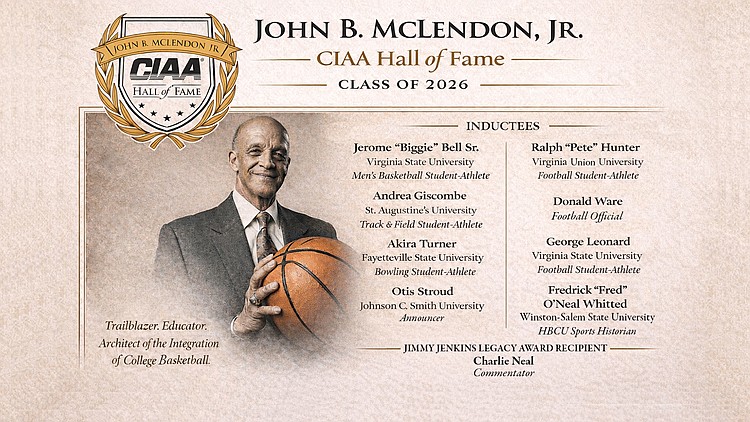
The Central Intercollegiate Athletic Association announced its 2026 John B. McLendon Hall of Fame class, recognizing former student-athletes, officials, administrators, historians and media figures whose contributions helped shape the nation’s oldest historically Black athletic conference.
The eight-member class will be inducted Feb. 27 during the CIAA Men’s and Women’s Basketball Tournament.
The 2026 class includes Jerome “Biggie” Bell Sr. of Virginia State, Andrea Giscombe of St. Augustine’s, Akira Turner of Fayetteville State, Otis Stroud of Johnson C. Smith, Ralph “Pete” Hunter of Virginia Union, Donald Ware of the CIAA, George Leonard of Virginia State and Fredrick “Fred” O’Neal Whitted, a longtime HBCU sports historian. Broadcaster Charlie Neal will receive the Jimmy Jenkins Legacy Award.
One of the most dynamic point guards in CIAA history, Bell starred at Virginia State from 1974 to 1979 and helped lead the Trojans to the 1975-76 CIAA championship. Known as “The Magician,” he remains the program’s career assists leader with 791 and holds multiple school and conference tournament records. His career included All-CIAA and All-American honors, and he was the first recipient of the CIAA Tournament Hustle Award.
At St. Augustine’s, Giscombe established herself as one of the most decorated athletes the conference has produced. Competing in track and field during the 1996-97 seasons, she captured five NCAA Division II individual titles and six CIAA championships, helping lead the Lady Falcons to the 1997 NCAA Division II outdoor national championship. She later spent two decades as an assistant coach, contributing to 21 NCAA national titles and 79 CIAA championships.
Turner remains one of the most decorated bowlers in CIAA history. She earned CIAA Player of the Year honors twice and was a four-time All-CIAA selection. Turner led Fayetteville State to four divisional championships and two CIAA titles while posting the conference’s highest average (200) in 2011. In 2021, she became the first bowling student-athlete ever inducted into the Fayetteville State University Hall of Fame.
For more than four decades, Stroud has been one of the most recognizable voices associated with CIAA athletics. A Johnson C. Smith graduate, he began his career as a public address announcer in 1977 and became a fixture at the CIAA Basketball Tournament, where his announcing style helped shape the atmosphere of one of the country’s premier HBCU sporting events.
Defensive dominance defined Hunter’s career at Virginia Union, where he emerged as one of the top defensive backs in CIAA and NCAA Division II history. After transitioning from wide receiver, he led the Panthers to the 2001 CIAA championship and recorded 11 interceptions that season. His performance led to selection in the 2002 NFL Draft, making him the only CIAA player drafted that year, followed by a six-year professional career in the NFL.
“Being inducted into the CIAA Hall of Fame is a tremendous honor that I accept with deep gratitude and humility,” said Hunter. “The CIAA represents excellence, tradition, and a legacy that helped shape who I am today. I share this honor with my teammates, coaches, family, and everyone who poured into me along the way. To be recognized among so many legends of this conference is truly special.”
Consistency and leadership marked Ware’s 31 years as a CIAA football official. He worked more than 200 conference games, including three CIAA championships, six NCAA Division II playoff games and the 2004 NCAA Division II national championship. He was also widely respected for mentoring younger officials and strengthening the conference’s officiating pipeline.
On the field for Virginia State, Leonard set the standard for running backs during his career from 1976 to 1979. He graduated as the Trojans’ all-time rushing leader with 3,575 yards and 33 touchdowns, earning CIAA Player of the Year honors in 1977 after rushing for more than 1,000 yards that season.
Preserving the history of Black college athletics was the life’s work of Whitted, who is being honored posthumously. A Winston-Salem State graduate, he founded Resources 2000 and authored several landmark publications on HBCU sports, becoming one of the nation’s leading historians of Black college athletics and a familiar presence at CIAA championship events.
Neal, the recipient of the Jimmy Jenkins Legacy Award, is being recognized for his pioneering role in Black college sports broadcasting. He called the first nationally televised CIAA basketball game and spent more than two decades at BET expanding national exposure for HBCU athletics, later continuing his work with major networks and HBCU-focused platforms.
The CIAA Hall of Fame is named for John B. McLendon Jr., a pioneering coach and administrator widely regarded as a central figure in the integration of college basketball and the expansion of opportunities for Black coaches and student-athletes.