Gospel musician Richard Smallwood remembered with music-filled funeral
By Adelle Banks Religion News Service | 1/29/2026, 6 p.m.
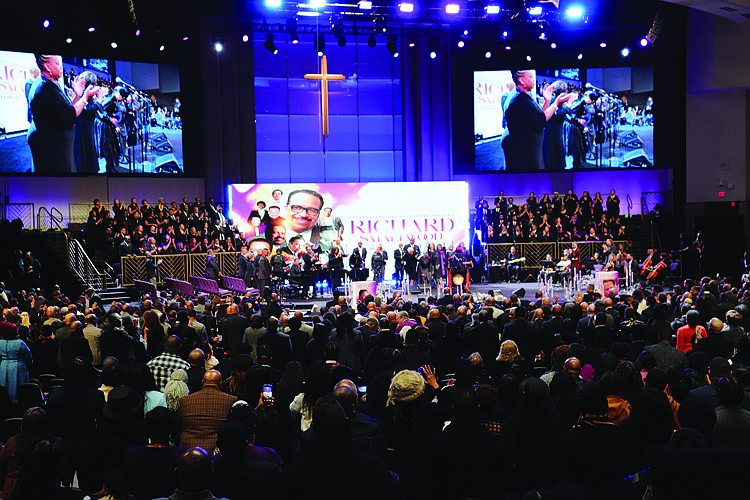
Thousands of fans of gospel music giant Richard Smallwood bid him farewell in a music-filled funeral Saturday, as family and friends of the composer remembered him for his creativity, his theology and his humility.
Smallwood’s black closed casket, covered with white flowers, stood at the front of the sanctuary of First Baptist Church of Glenarden, just east of Washington, at the 2 1/2-hour service dominated by the songs he wrote.
Pastor Maurice Watson, the former pastor of Smallwood’s Washington-area home congregation, preached on Psalm 121, on which Smallwood based one of his most widely sung works, “Total Praise,” which begins with the words “Lord I will lift mine eyes to the hills, knowing my help is coming from You.”
“His music had a depth to it that spoke to our souls and to our hearts,” said Watson, who led Metropolitan Baptist Church, where Smallwood was a member and was ordained. “His music was high enough to make the erudite sit up and listen, but it was low enough to inspire and give hope to the common person.”
Smallwood, an eight-time Grammy Award nominee, died in Sandy Spring, Maryland, on Dec. 30, 2025, at age 77 of complications from kidney failure. Born in Atlanta, he was raised mostly in Washington, where he was influenced by his stepfather, the Rev. Chester Lee “CL” Smallwood, who pastored the district’s Union Temple Church, and his mother, Mabel, who took him to performances of the National Symphony Orchestra.
Twenty-five minutes before the doors to the megachurch opened at 9:30 a.m., dozens of people huddled outside as others sat in idling cars in 10-degree weather. By the time the funeral began at noon, the predominantly Black audience, dressed in boots and puffy jackets, furs and high heels, scarves and sneakers, filled most of the seats of the church’s main auditorium.
In a recorded video presentation that preceded the service, Smallwood described how “Total Praise” has been sung around the globe, his words illustrated by clips of the tune being played by Stevie Wonder on the harmonica, by the Florida A&M University marching band and by choirs from Italy to Ghana to Japan.
“Total Praise,” which Smallwood introduced with his group Vision in 1996, was also covered by Destiny’s Child, performed by a cantor at Carnegie Hall in New York, and sung by a choir as President Barack Obama welcomed Pope Francis to the White House in 2015.
Near the end of the funeral, the song was featured twice more, first in an instrumental version played by pianist Joseph Joubert and then sung by Vision and the Celebration Choir, a collection of singers from different phases of Smallwood’s life, Metropolitan, Union Temple and Howard University’s gospel choir.
Reflecting Smallwood’s longtime interest in classical music, the prelude and postlude to the service were played by a string ensemble, including works by Johann Sebastian Bach, whom Smallwood called his “favorite classical composer on the planet.”
The gospel musician Stephen Hurd, who is also ordained, expressed his gratitude for Smallwood’s knowledge of Scripture, but also music theory.
“Even as we want to mourn and we want to cry, oh God, we are rejoicing because had it not been for a Smallwood song, some of us would not have learned our circle of fifths,” Hurd said in offering the “prayer of comfort.” “Had it not been for a Smallwood song, some of us wouldn’t have learned how to play in different keys. Had it not been for a Smallwood song, some of us would not know how to articulate Scripture in melody.”
Others recalled that Smallwood both inspired and helped found choirs at his stepfather’s church and at Howard University. After he became a well-known recording artist, Smallwood often returned as a “humble servant” to Metropolitan Baptist, still dedicated to perfection.
“He believed that the choir loft was holy ground and that preparation itself was an act of reverence. Through him, we learned that excellence is not elitism,” said the Rev. H. Beecher Hicks Jr., a former longtime leader at the church who attended the service but spoke via recorded video.
With his early gospel group, the Richard Smallwood Singers, and with Vision, Smallwood recorded such hits as “Anthem of Praise,” “I’ll Trust You” and “Center of My Joy,” the latter co-written with Bill and Gloria Gaither. “I Love the Lord,” originally recorded in 1976 with a Union Temple choir, was re-recorded by the singers in 1982, with Dottie Jones as the lead singer. At the funeral, Jones sang the song, which was later remade for the soundtrack of the 1996 movie “The Preacher’s Wife,” in a version sung by Whitney Houston and the Georgia Mass Choir.
Also Saturday, Maryland Gov. Wes Moore recalled reciting lyrics of “I Love the Lord” on the day he won his office three years ago.
“Election morning, he was our soundtrack: ‘He heard my cry,’ was how we started that morning,” said Moore, who went on to sing a brief part of Smallwood’s “Center of My Joy.”
“He was a true vessel of God’s love at a time when we needed it,” he said. “He was always there to provide the lift that we needed and, Lord have mercy, in the world right now, we need his voice.”
Moore also read an official proclamation honoring Smallwood. His tribute followed others previously acknowledged in the service by dignitaries including Bill and Hillary Clinton, Barack and Michelle Obama, Kamala Harris, Washington Mayor Muriel Bowser and U.S. Sen. Angela Alsobrooks, who met with the Smallwood family before the service.
But the greatest tribute to Smallwood may be that in the weeks after his death, he and his songs have been remembered at worship services in churches across the country, where his music will doubtless live on.